Water Taxis and Wat Pho

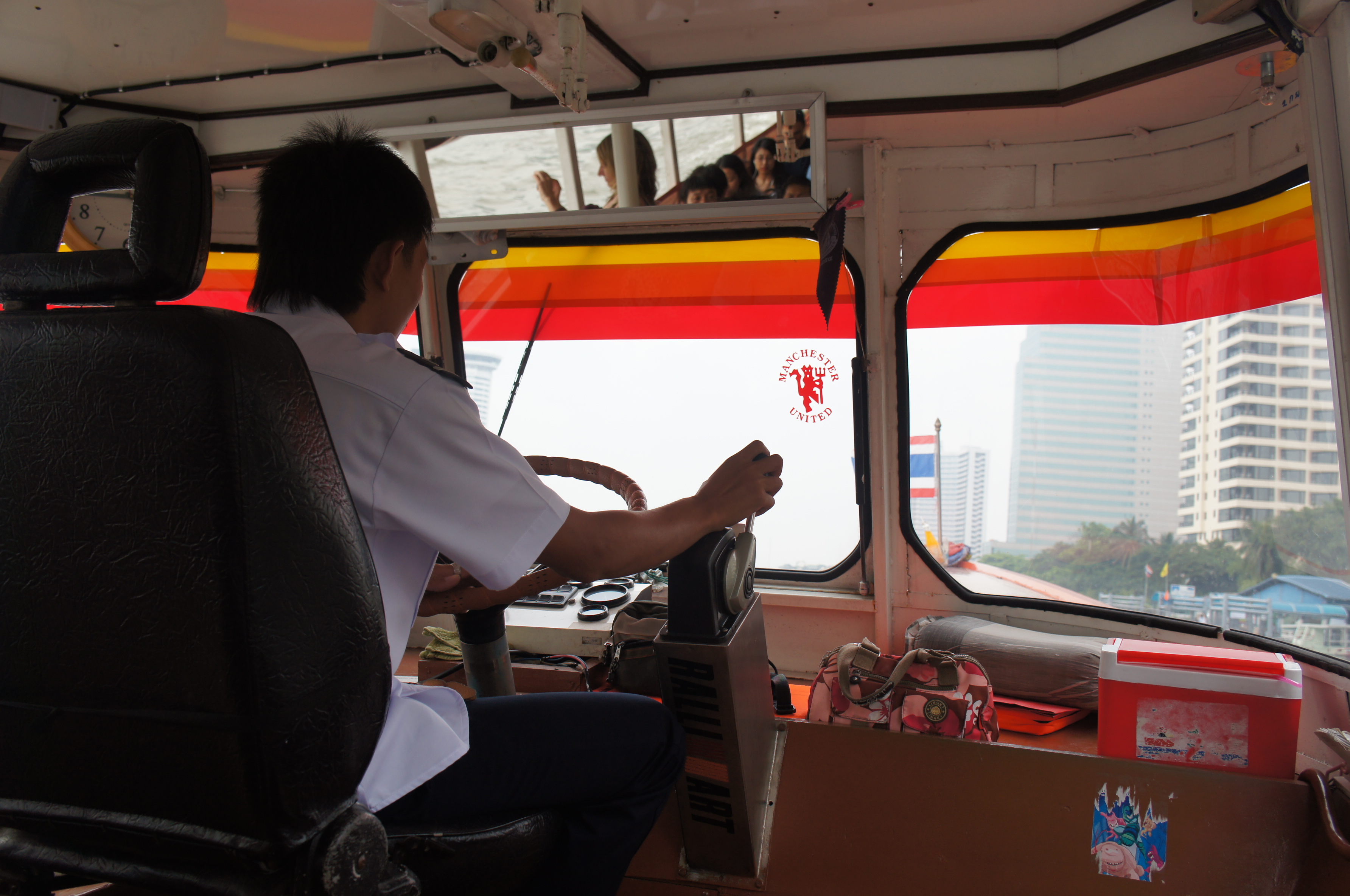
Water Taxi Driver

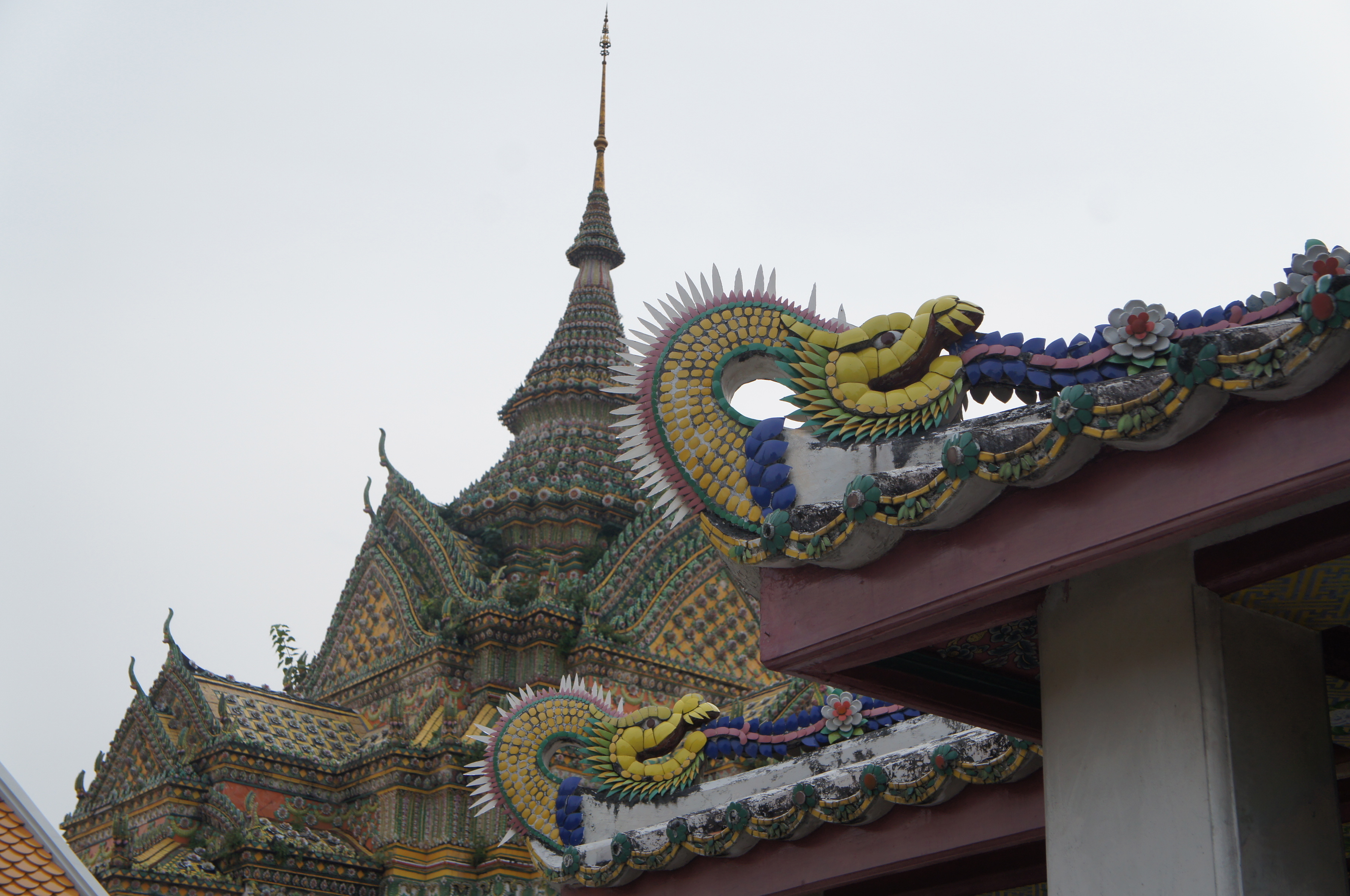
We leave our hidden oasis at the Jim Thompson House for another Thai landmark, Wat Pho, a temple dedicated to traditional Thai massage and a clear sign that the Thai take their massage seriously. But we must, literally, navigate another mode of transportation to get there–water taxi, which is way grittier than the Sky Train. The platform rolls under our feet as we climb aboard at Saphin Taksin. A woman shakes a tin can in the direction of new passengers to pay up in exchange for a small red and white paper ticket. It’s 15 baht, about 50 cents to ride. We spy long-tail boats for the first time on our trip, narrow skiffs with a small motor attached cruising Bangkok’s Chao Phrya River. We know we’ve arrived, about 5 stops later when an ancient conical tower appears amidst the skyscrapers lining the river. We think it is Wat Pho, but it is another temple, Wat Arun. The one we seek is just beyond a row of street vendor stalls, smelling of dried fish. But Wat Pho’s glittery gold roofs are beckoning. Once inside we are stopped by huge stone guards armed with swords. Nancee and Karen have to pose with them mimicking their menacing stances. But gangs of tourists have gotten beyond the guards pointing their cameras at whimsical multicolored spires stretching into the sky. Apparently one Indian tourist has lost their camera because there’s a man yelling through a bull horn for them to come pick up their camera from a tent in the middle of this crowded scene. We know the tourist is Indian because the man has looked at the pictures and is describing the people in them all over the bull horn. It’s a little distracting in what is supposed to be a sacred site.
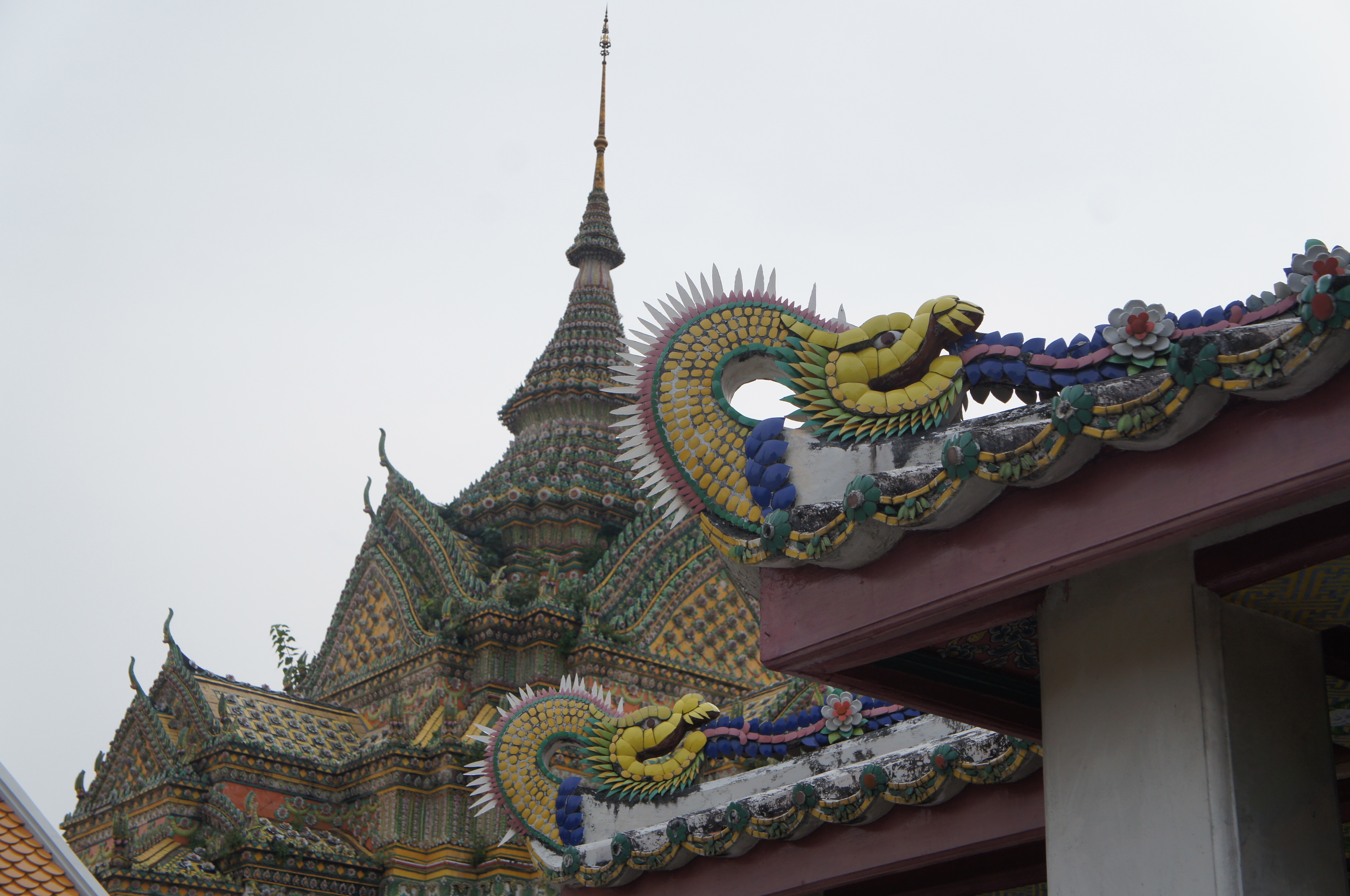
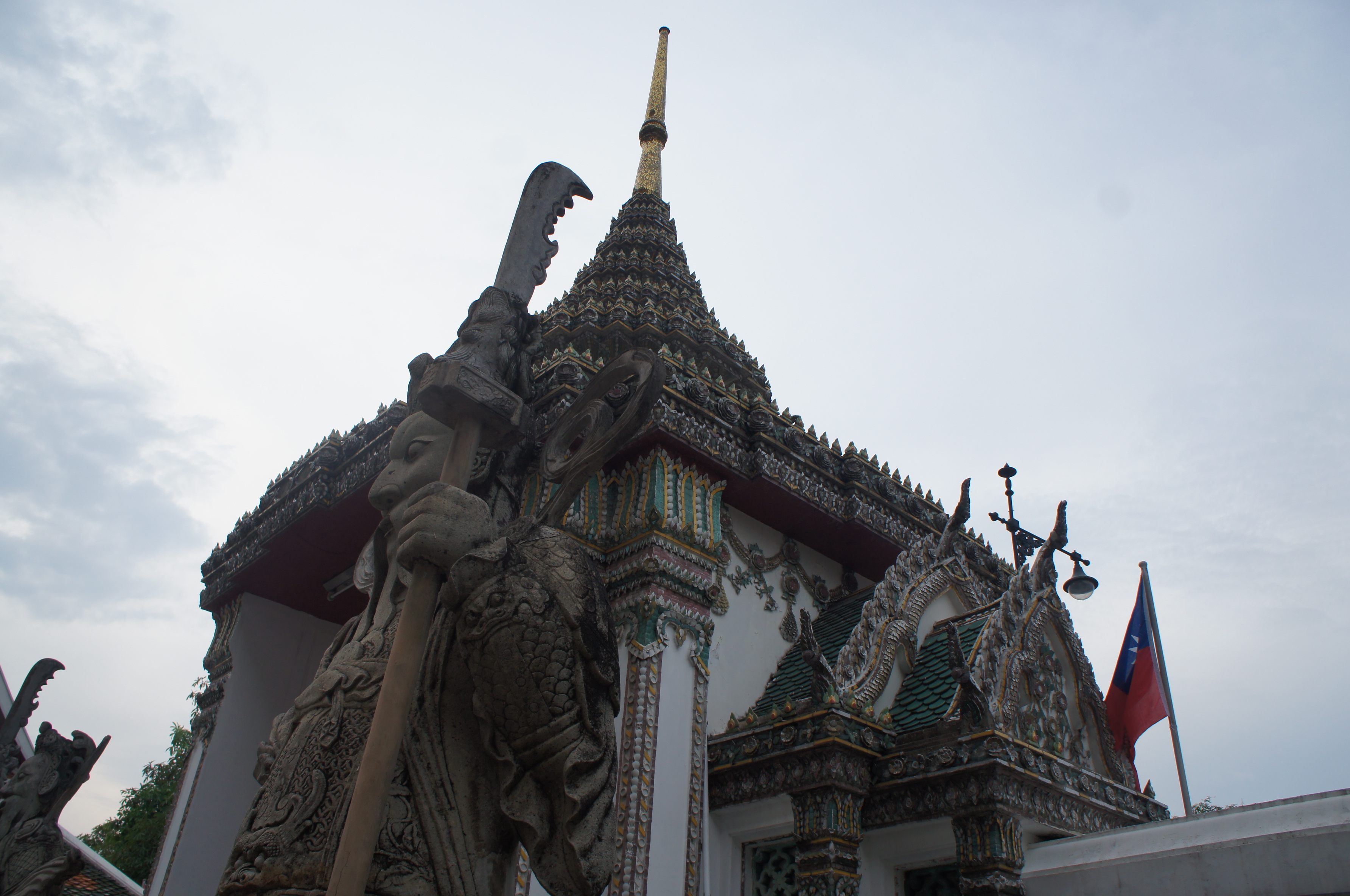
The roofs at Wat Pho
Wat Pho Guards

The main attraction drawing the crowds is a giant, neck-craning reclining Buddha, measuring 150-feetlong and 49 feet tall. The gold resplendent figure barely fits into its small temple and streams of people cluster at the entrance to get a photo its serenely happy face. It’s almost impossible to capture the Buddha in its entirety on one photo but everyone tries, while inserting themselves into a few frames themselves. His feet are a whopping 9 feet tall and 16 feet long, decorated with Mother of Pearl. He is to say the very least impressive and worthy of the adoration.
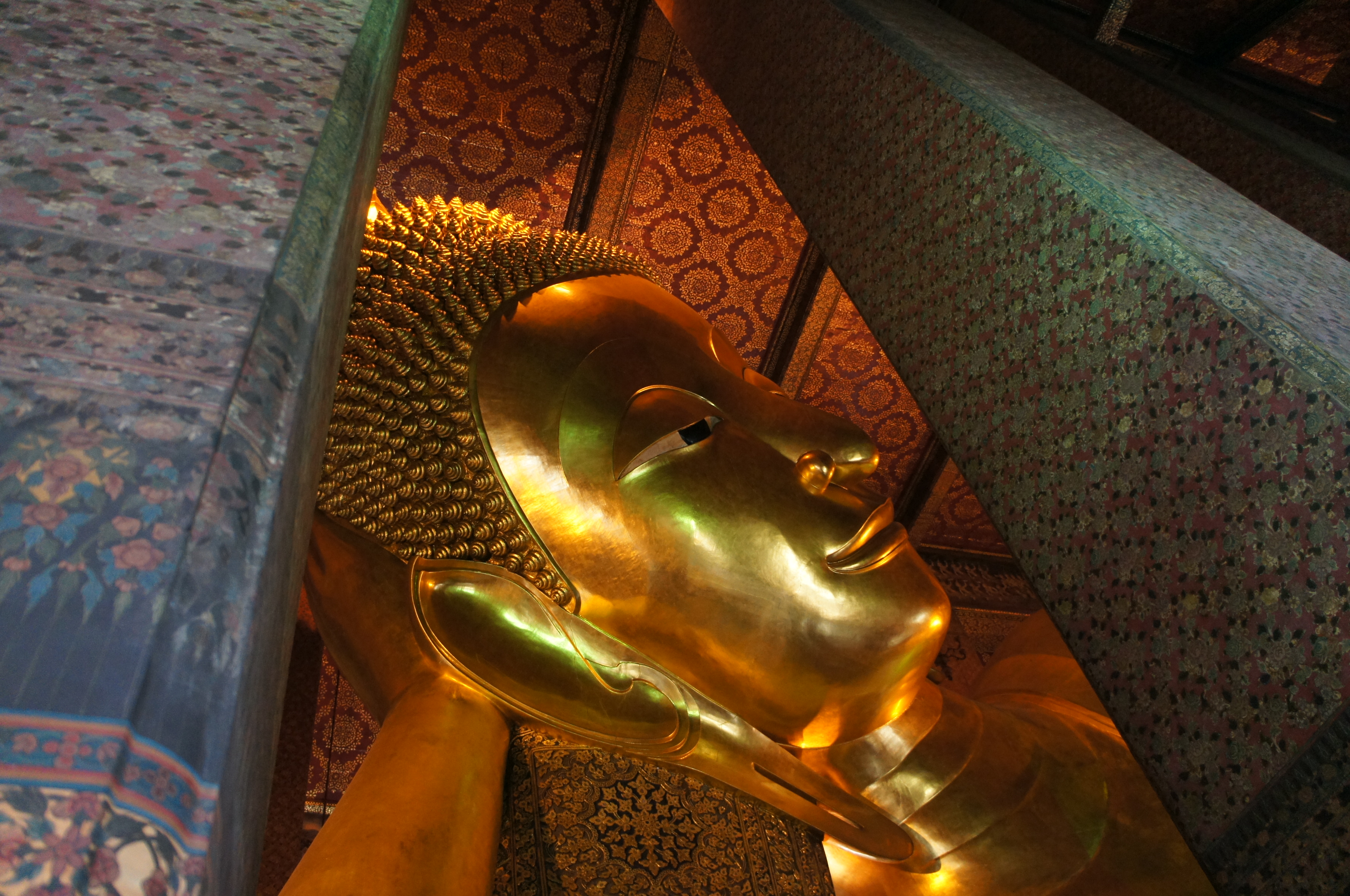
Wat Pho’s Reclining Buddha
Mother of Pearl encrusted Buddha feet

The size of this Buddha matches his surrounding at Wat Pho, which are expansive and just as fancy. The temple complex is huge and we split up to try to take in as much as we can. Spires print up from the ground and nested doorways invite us to explore courtyards lined with rows and rows of seated Buddhas. Chanting emanates from a temple at the center of the complex featuring a Buddha that seems to emanate light, it is so golden. This one is seated atop an ornate pedestal and monks in saffron robes kneel before it chanting without a breath. The chants envelop us and I believe this is what true devotion feels like.

Monks at Wat Pho

The sun is starting to set and we are about to leave when I remember that this temple is also dedicated to Thai medicine and massage and the home of the country’s first government approved school for massage. And, what better way to end of day of sightseeing than with a massage? Karen opts for a foot massage and Nancee and I go for the 30-minute full body Thai massage, costing 260 baht or around 8 bucks. An amazing value for a fully-clothed massage that starts from your calves, goes to your head and seems to force every muscle in between into loose submission. My masseuse, Ann, is small but she’s strong and uses her full weight to press tension out muscles and stretch limbs in ways you never thought possible. I ask Ann how long she has been doing this. She says 10 years. Her hands say it all. Karen seems content with her foot massage and Nancee says her massage was a bit too forceful for her tastes, but we are all pretty relaxed afterwards.

Wat Pho by night

By this time it is nightfall and we make our way back onto the water taxi to head back to Lyle’s. Unfortunately we head in the wrong direction for about 30 minutes before the lady with the tin can asks where we are going and says we should get off and catch a taxi heading in the other direction. But it turns out to be good fortune because we’ve seen Thailand at night, a brilliantly lit bridge and skyline reflected in the river along with a special treat, barges festooned with colorful lights and themes featuring giant images of Thailand’s king and queen. One boat is blowing bubbles from its top and another boasts boldly, “Green Energy.” We learn later from Lyle that this display is probably a precursor to the upcoming Loy Kratong Festival to pay homage to the goddess of the rivers and water ways. Sometimes it’s good to take a wrong turn. You never know what you might miss.
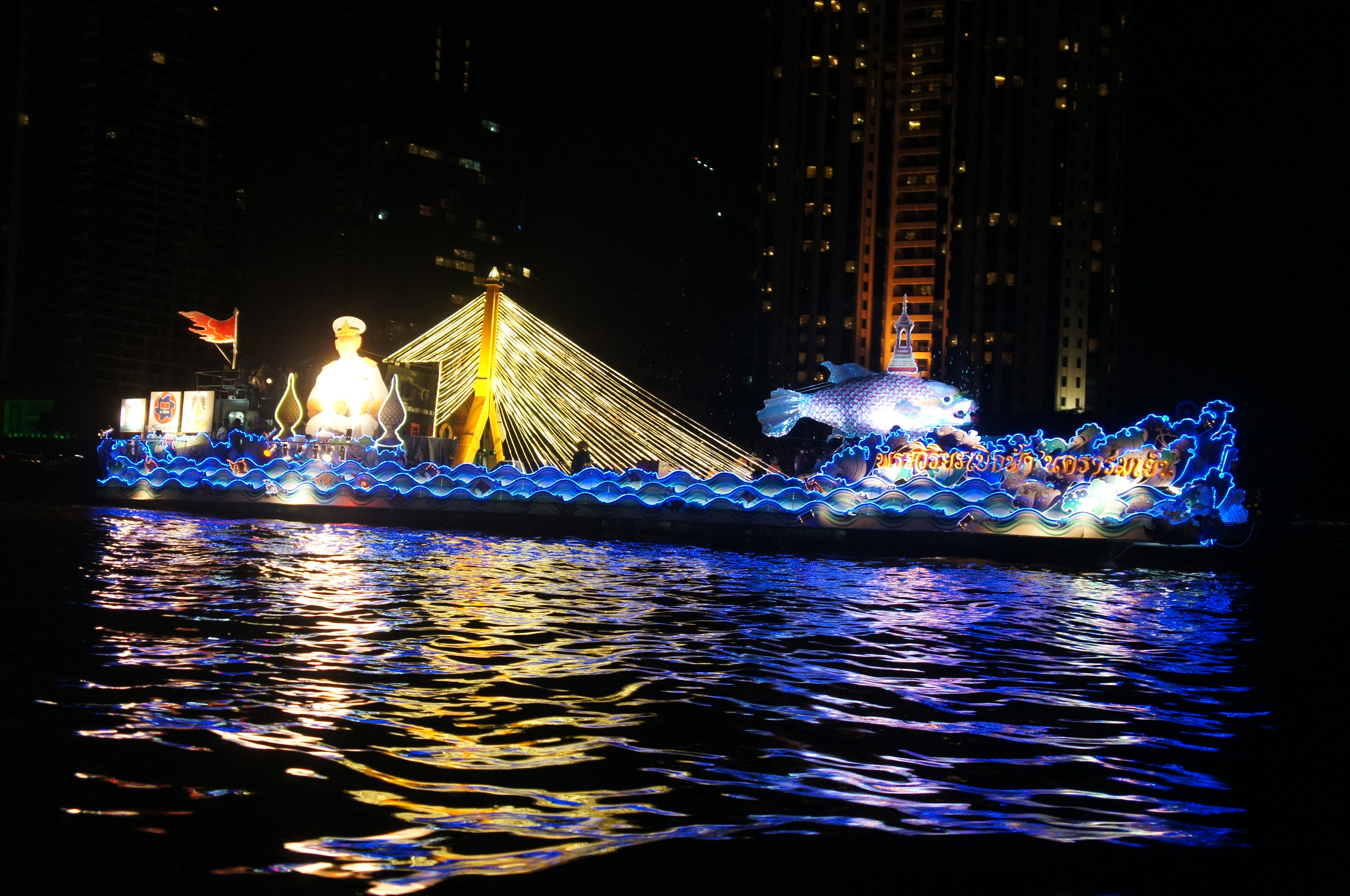
Water Festival Boats on Chao Phrya River

We are famished when we return and Lyle suggests one her her favorite spots in the neighborhood, Puangkaew. Lyle says a friend of her’s travels across town from Chinatown to eat at this place and we can see why. I have the spiciest papaya salad I have ever tasted and a delicious Chee Choo Gong or prawns in red curry sauce. The prawns seem to be fried whole and drenched in a coconut curry cause with kick. I cool the spice with a Singha beer, Thailand’s official brew. We can barely keep our eyes open over dinner as we fight off the effects of jetlag and a really good Thai meal.

Chee Choo Gong

Sky Trains and a Spy Who Loved Silk

Author’s Note: I’ve been lax in posting from Thailand because there has been so much to see and do! So here are two posts from one day of adventures!

The third member of our traveling party arrived on Monday morning, albeit a tad later than expected. We expected Karen in on Sunday, but she miscalculated her arrival, failing to factor in a 7 hour layover in Frankfurt. But, now, all the players in this great Thailand-Cambodia adventure are in place: Karen, the Brooklynite who’s lived in London traveled to Peru, Tanzania, Madagascar and other far flung places and Nancee, my DC writing buddy, who’s studied in Spain and tripped about in the Caribbean. I know these ladies through a mutual friend who couldn’t make the trip. (We’re thinking about you, Kim). I mentioned that I was planning to go to Thailand and they all said they wanted to go, too. So, here we are.

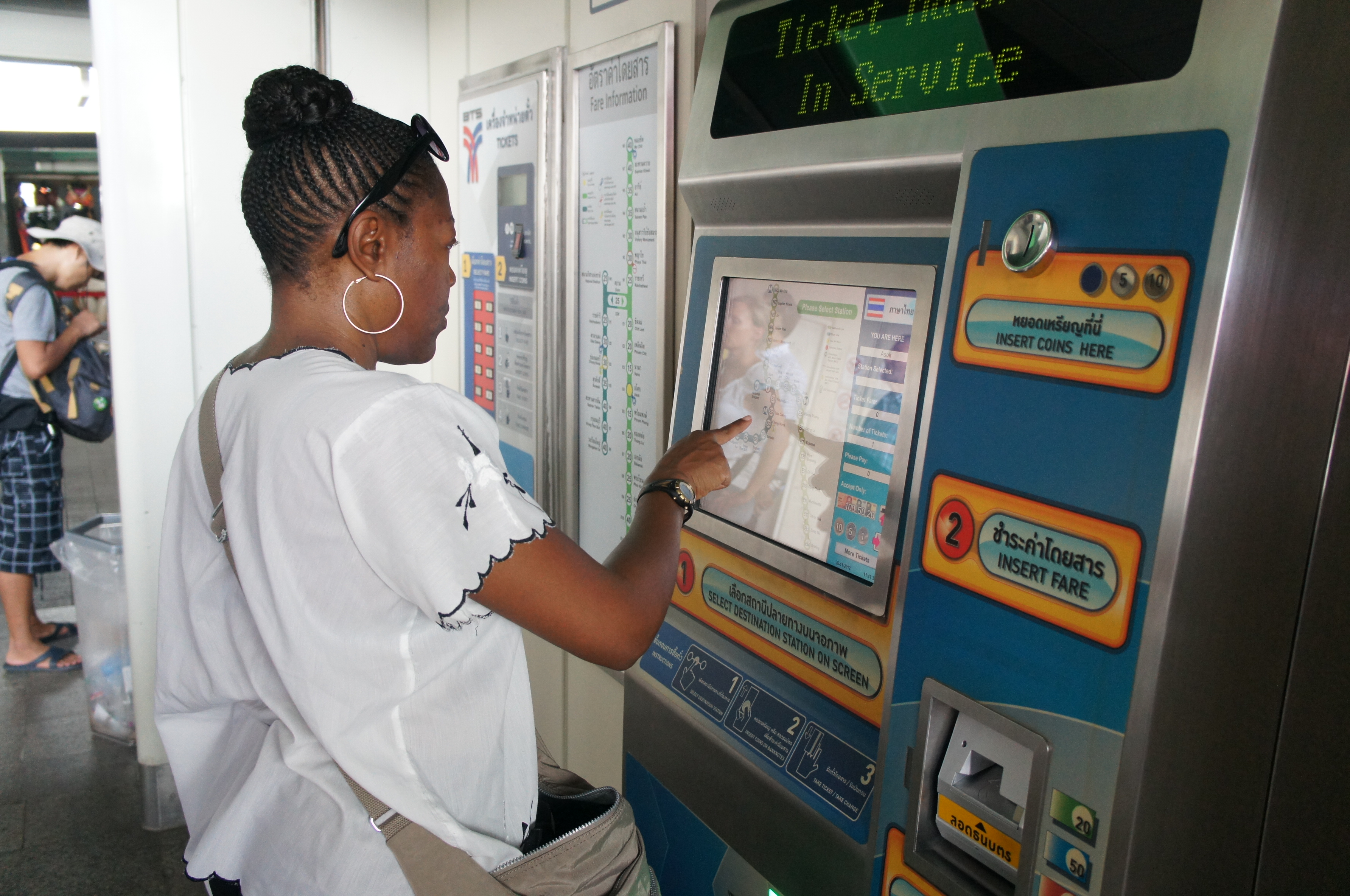
Buying a Sky Train ticket

On our first day together we decide to visit a couple of Bangkok’s major sites–The Jim Thompson House and Wat Pho. But not before taking on Bangkok’s Sky Train. At the Asok station near Lyle’s apartment, we weave through a steady and disorienting stream of Thais going about their Monday afternoon business, attempting to figure out one of their main modes of public transportation. And we actually take to it quite well. The ticket machines are brightly-colored and feature the system map along with each destination and the cost to get there from your current location. It’s pretty much idiot proof. Select the fare to your destination (in this case 40 baht or a bit over $1 to reach National Stadium), put in your money and the machine spits out a pretty blue ticket. The only thing is the machines don’t take bills, so you have to go to a booth to get change from a teller. At first we thought we could buy tickets from the uniformed teller in the station and were confused when we only got change back after asking for a ticket. The trains are absolutely immaculate, but they quickly become jammed with passengers depending on the stop. At our Siam transfer point we had to make a mad dash to get on a car that wasn’t overly packed with passengers. If this were NYC or even DC, there would be some unpleasant jostling for space or someone’s arm getting caught in he door. But not here; everyone manages to get on in a very polite and orderly fashion. The passengers are a mix of Thai society from well-dressed ladies with the latest designer handbags to the university students who must wear a uniform of white blouse and belted black skirt, a pairing that is actually quite cute. Lyle’s nanny Ngea was wearing the same outfit earlier today. She explained that younger students much wear longer skirts and older students have their choice between longer and shorter skirts. Ngea is studying eco-tourism and has been preparing for a big economics exam. I wonder what degrees the students on the train are pursuing.


Bangkok’s Sky Train

Before we know it we are at our stop and follow the flow of Thais from the Sky Train onto the busy street below. The Jim Thompson House feels like an oasis in the chaos that is Bangkok. It feels particularly serene after our adventure on the Sky Train. In the courtyard of the The Jim Thompson House (admission 100 baht, $3.25), there is a Thai man spooling a thin tread of silk from and steaming bath of silk worm cocoons. The man appears to be a representation of Jim Thompson’s passion for silk. Thompson, an American, was an officer in the Army’s Office of Strategic Services, a precursor to the CIA, when he lived in Bangkok in the 1940s. He fell for the place as many Americans do. Lyle’s husband, Peter, told me that Thailand has the most American expats after China. Thompson eventually left the Army to become an entrepreneur in Thailand’s silk trade and his home became the center of Thailand’s expat scene, a lovely complex of 6 traditional Thai homes in one.

The Jim Thompson House
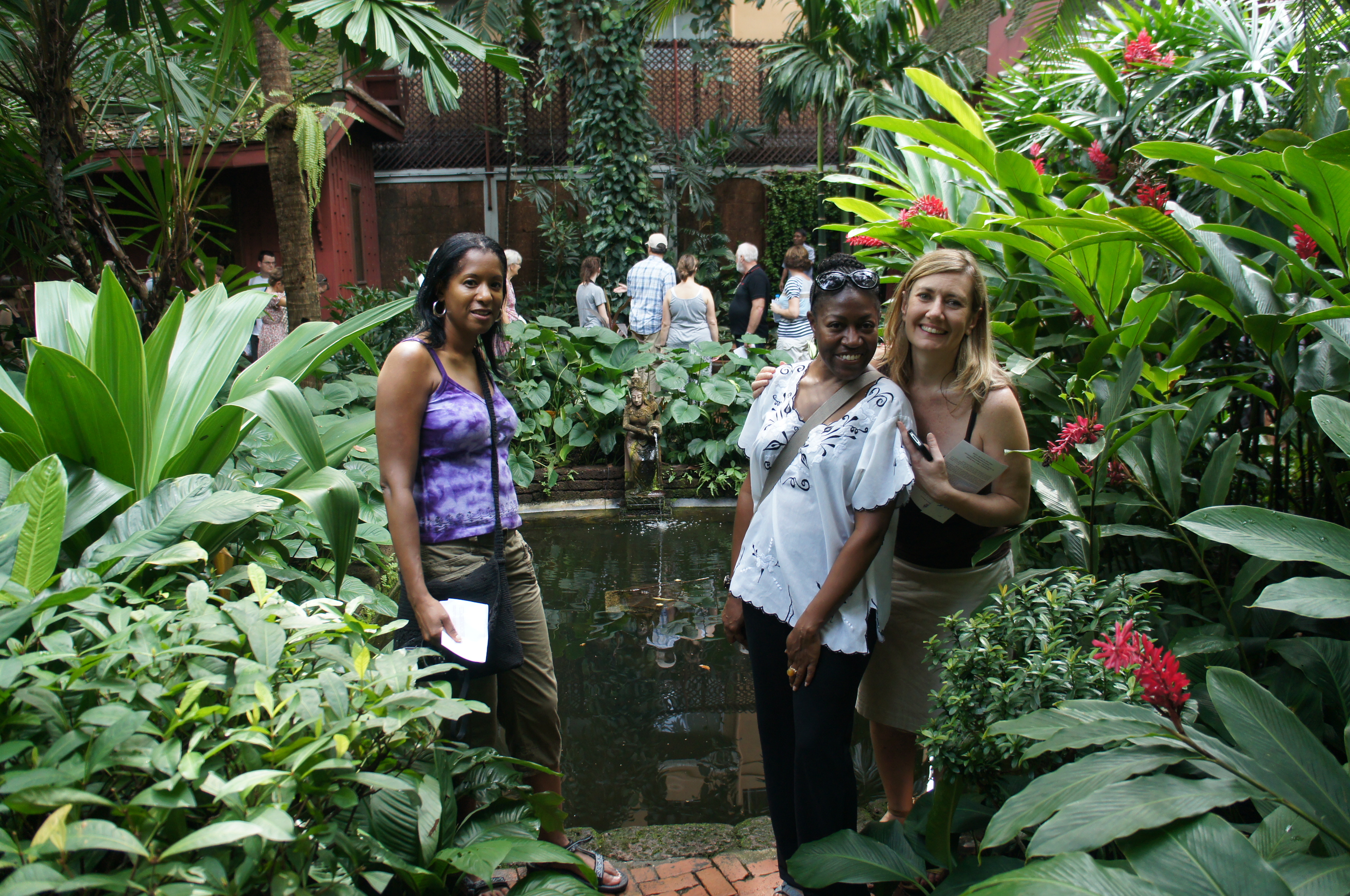
Nancee, water-pouring god, me and Karen

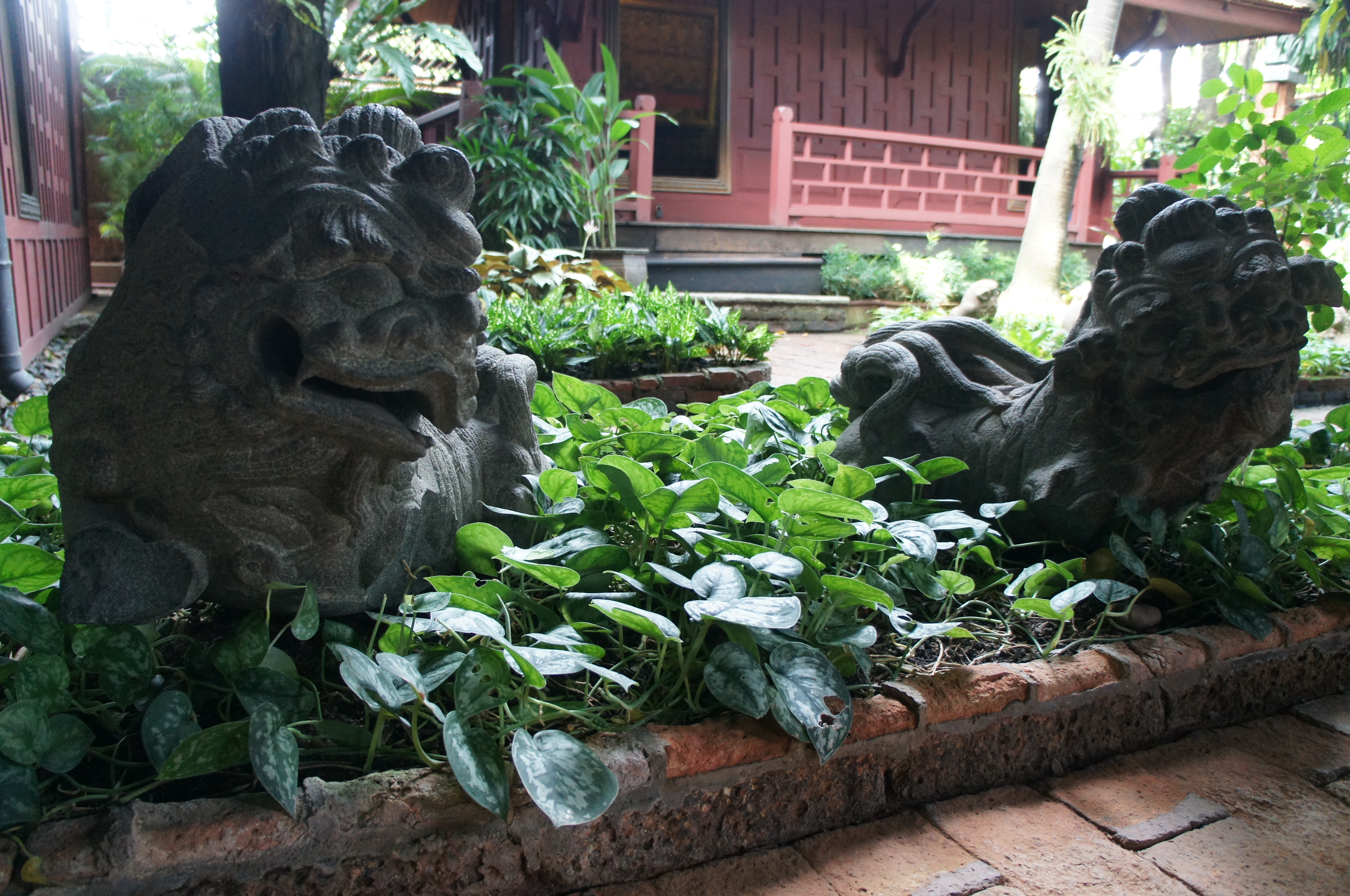
We explore Thompson’s urban tropical jungle, featuring water-pouring gods and other mythical creatures lurking in leafy green foliage, as we wait for our guided tour of the place. We already can tell that Thompson must have had an incredible green thumb and an impeccable sense taste for Thai art and design. Our guide explains that he added some western touches from the Italian marble in the western-style foyer of his home to the addition of a ceiling, where most Thai homes had none. Nancee, Karen and I love the furnishings throughout the house from the mahjong, turned dining table in the dining room to the lamps made from ancient drums. We spot plenty of pieces we’d want in our homes. Our guide tells us that Thompson disappeared mysteriously from a vacation with friends in Malaysia in 1967. To this day, no one knows what happened to him. Some people believe that a wild tiger ate him while he was on a trek alone. Karen asked the guide who got Thompson’s estate. She says that it was his nephew. So, we devise our own theory: The nephew offed his uncle for this amazing house. But the more likely scenario is that he was hit by a truck and the driver hid his remains.

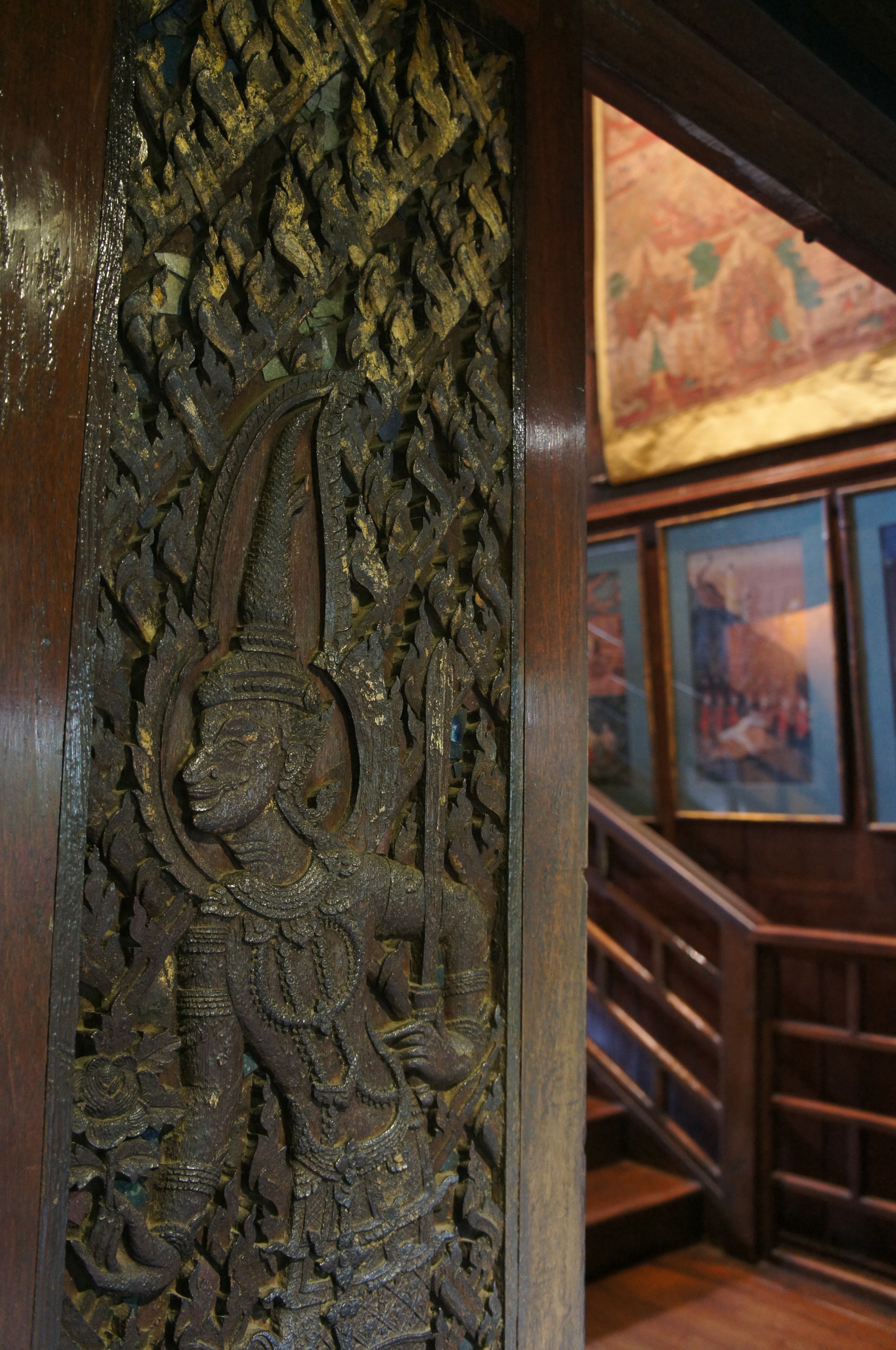
Glimpse of interior of Jim Thompson House

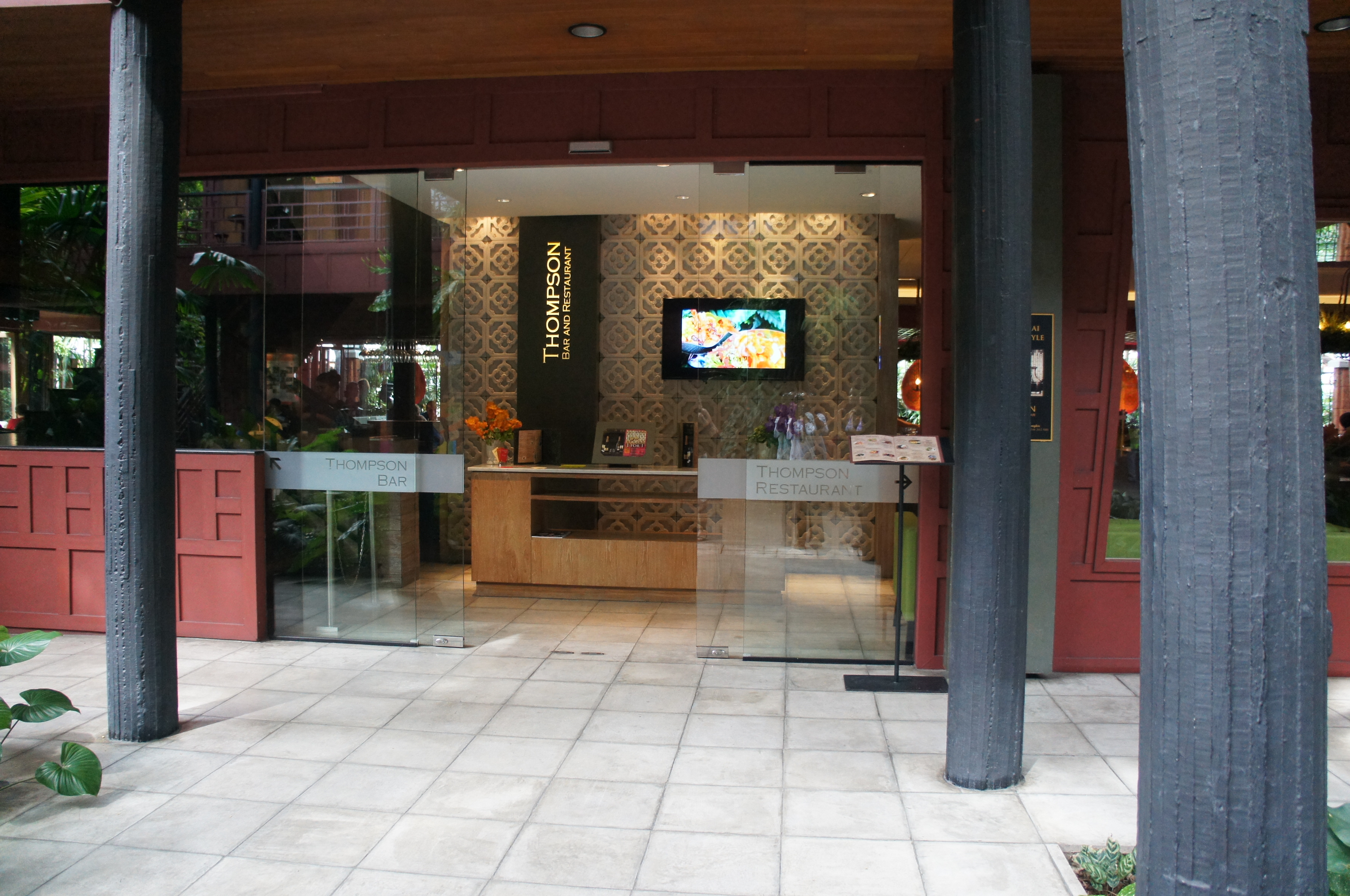
At the end of our tour we have lunch at the Thompson Bar and Restaurant on the premises, which is still a local hang out. The restaurant is chic and minimalist, bordered by a Koi pond. I have a tasty Pad See Ew and my second fruit smoothie since arriving in Thailand, a lychee lemongrass mixture. Fruit smoothies or shakes seem to be big here, coming in a variety of tropical fruit flavors like watermelon, coconut, mango and pineapple. These aren’t like our smoothies or shakes mixed with yogurt, milk or ice cream, these are blended bits of real fruit and deliciously refreshing on a hot Bangkok day.

Thompson Restaurant and Bar

Read on for part 2 of this day’s adventure: Water Taxis and Wat Pho.